Dialing the Wrong Address: Why Hollywood Killed Stargate, and What They Lose When They Snub "Dad Sci-Fi"
Unscheduled Off-World Activation: Why Amazon’s Feed Belongs to the Fans Now

The entertainment industry is currently suffering from a severe case of focus-group amnesia.
Just a few weeks ago, the Stargate fandom was riding an absolute high. Seven months after Amazon MGM Studios greenlit a new series order under franchise veterans Martin Gero and Joseph Mallozzi—promising a genuine continuation of a 25-year TV canon rather than another uninspired, sanded-down reboot—the studio abruptly pulled the plug.
The reason leaked to Variety? Executives worried the scripts “appealed too deeply” to the existing core fanbase and wouldn’t achieve “broad mainstream appeal.”
Let that corporate logic sink in for a second: A built-in, fiercely loyal fanbase is now viewed by studios as a financial liability.
The backlash was instant. While executives hid behind dashboards, the fandom took action. They didn’t just tweet; they crowdfunded a literal banner plane to fly over Amazon MGM Studios in Culver City on June 16th, shouting #SaveStargate into the California sky while nearly a hundred thousand people watched live streams and tracked the push online.
This happened despite the studio having already funded a writers’ room through nearly 20 weeks of script development. This isn’t just a group of upset sci-fi nerds. It is a cultural phenomenon that exposes exactly why modern television is breaking down.
The Starvation for Wholesome Adventure
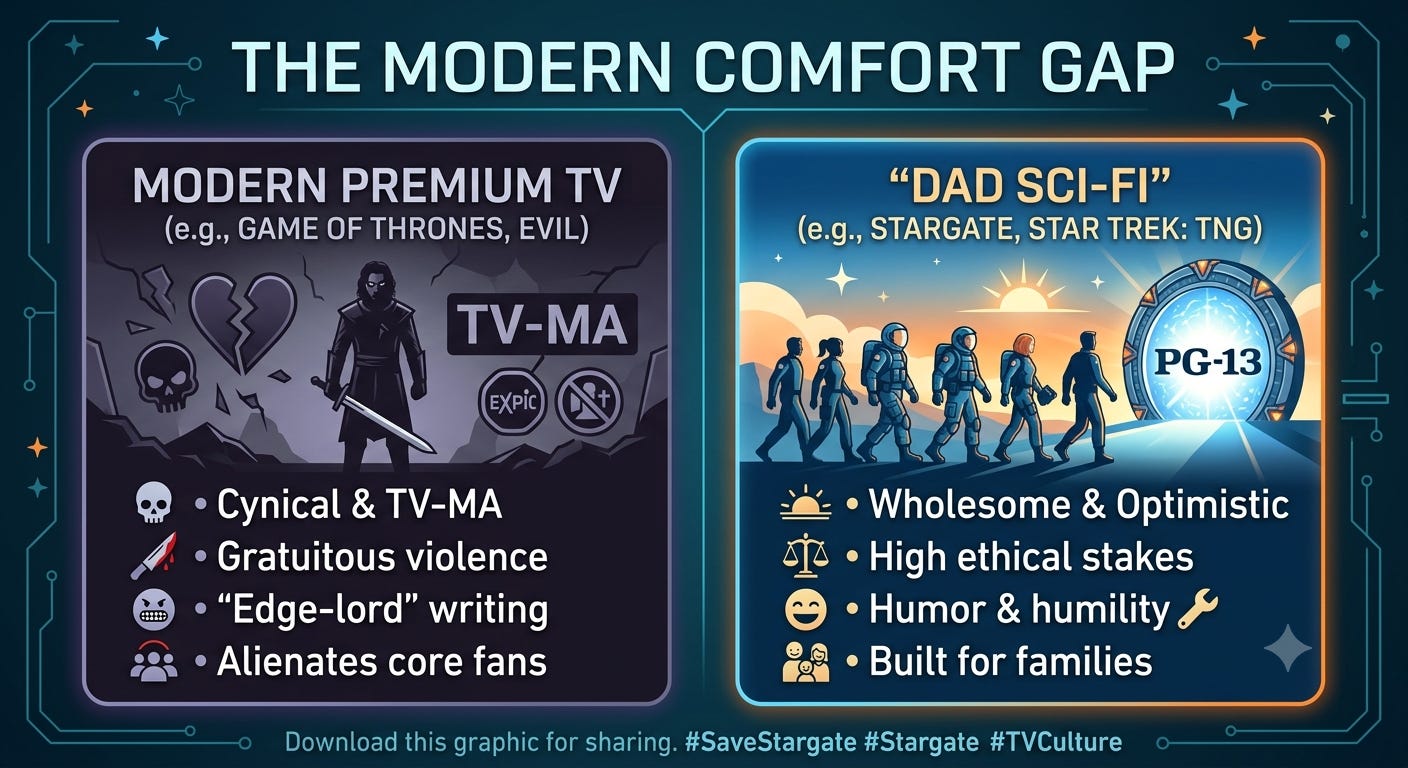
We live in an entertainment landscape dominated by two extremes: hyper-dark, cynical deconstructions, or hollow, focused remakes that use legacy titles as mere set dressing.
Look at Game of Thrones. Visually stunning, certainly, but its immediate reliance on gratuitous, edge-lord shock value and explicit content meant millions of families took one look and chose to walk away. Look at the fascination with the dark and demonic in shows like Evil or Lucifer. There is an exhaustion settled over audiences who are weary of watching characters break bad, act entirely out of self-interest, or wallow in grim reality.
People are starving for television that treats competence, optimism, and wonder as virtues.
Stargate was the ultimate baseline for this—the gold standard of “Dad Sci-Fi.” It was a show you could watch with your kids and your grandparents. It didn’t take itself too seriously—it could do a silly, brilliant groundhog-day episode one week (fan favorite Window of Opportunity), and tackle a massive, gut-wrenching ethical dilemma the next. The characters actually liked each other. They trusted each other. They were competent military personnel and scientists working together to solve problems using intellect and teamwork, not brooding characters backstabbing one another for drama.
Overriding the Gate: The Battle for the Comments Section
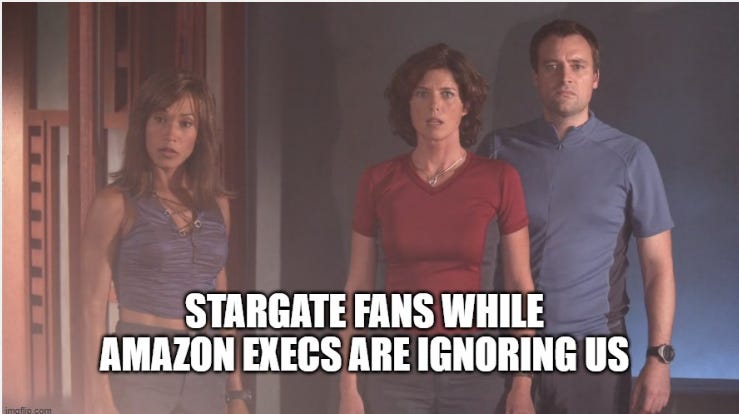
If Amazon executives thought a standard corporate cancellation notice would quietly fade into the background, they completely miscalculated the environment of modern social media.
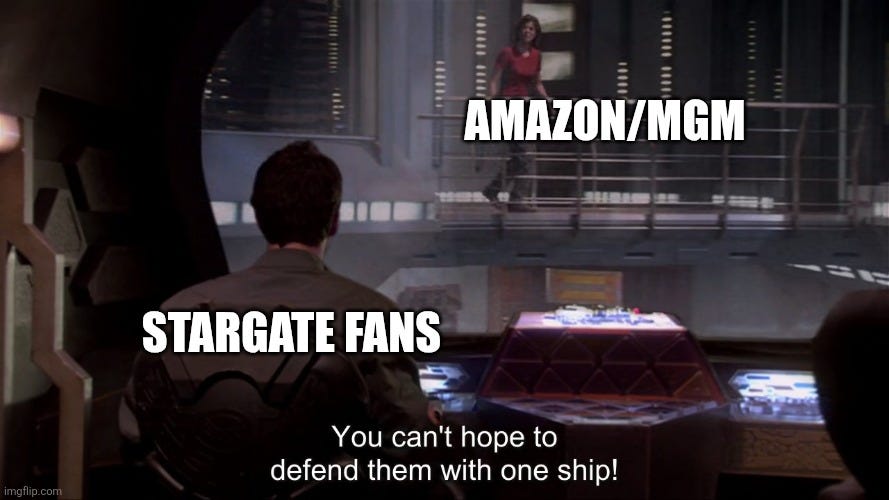
Right now, the official Amazon and Prime Video accounts on X are getting absolutely ratioed to the moon. Every single time a studio account attempts to post a promotional ad or a teaser for another television show, the comment section experiences an unscheduled off-world activation. It is instantly hijacked by thousands of Stargate fans dropping #SaveStargate demands, custom memes, and data points.
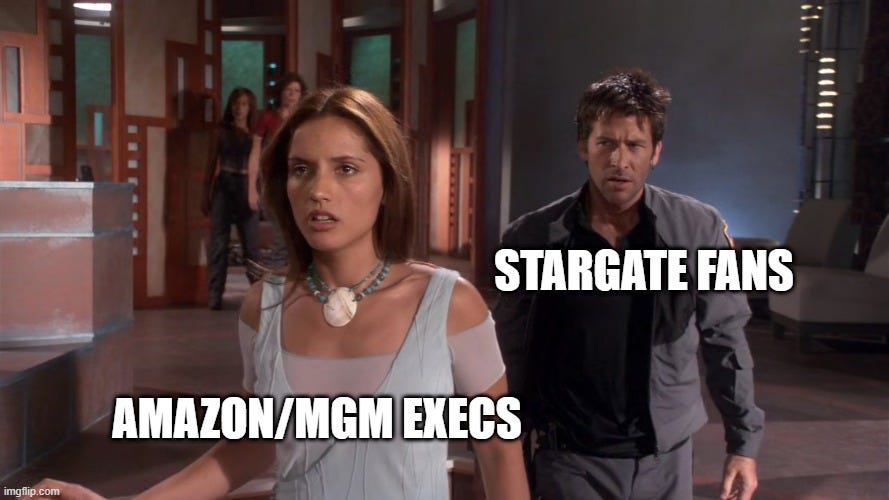
By drowning out the marketing for Amazon's other assets, the fandom is proving a vital point: an ignored audience won't just sit quietly in a corner. They will actively disrupt the algorithms until the boardroom is forced to look up from its data dashboards.
Fandom is an Asset, Not a Liability
The great irony of Amazon’s decision is that they already possess the perfect counter-argument in their own catalog: Fallout.
Fallout succeeded precisely because it trusted its dense, weird, 25-year-old continuity. It didn’t sand down the edges for a mythical “modern mainstream audience.” It fed the fandom, and when you feed a fandom, they do your marketing for you for free, at a scale no corporate budget can replicate.
Instead, streaming platforms keep burning billions chasing generalist blockbusters while canceling projects that have guaranteed, built-in audience retention. When you treat legacy lore with contempt, the resulting shows fail with everyone.
Why the Fight Matters
We know the realities of modern streaming production. We know the writers’ room has been disbanded and the pre-production plans halted. The chances of a corporate pivot turning the gate back on are slim.
But the #SaveStargate movement isn’t just about demanding a piece of media; it’s a pushback against the cultural shift that tells us television must be dark, cynical, or shallow to be relevant. There are literally unlimited stories left to tell in the Stargate universe, and an audience waiting with open arms to receive them.
If Hollywood won’t build the gate, fans will keep writing it in the sky.
Where Hope Dialed In: The Power of an Open Gate
It’s easy to look at the cold math of Hollywood contracts and assume the fight is over before it begins. But if the history of science fiction has taught us anything, it’s that corporate boardrooms rarely get the final word on what stays dead.
Decades ago, a grassroots letter-writing campaign saved Star Trek from a premature cancellation, paving the way for generations of television. Years later, unrelenting fan passion brought Farscape back for a proper finale and convinced networks that Firefly deserved a feature film.
The #SaveStargate movement is building that exact same kind of historic momentum.
This isn’t just an isolated pocket of the internet shouting into a void. Look at the front lines of this fight. Longtime franchise producer Joseph Mallozzi is handing ammunition directly to the fanbase on X. In a heartbreaking blog update Mallozzi confirmed the original vision was no more, but he later wrote on his June 6th post that fans matter an immense economic amount to the survival of a brand.
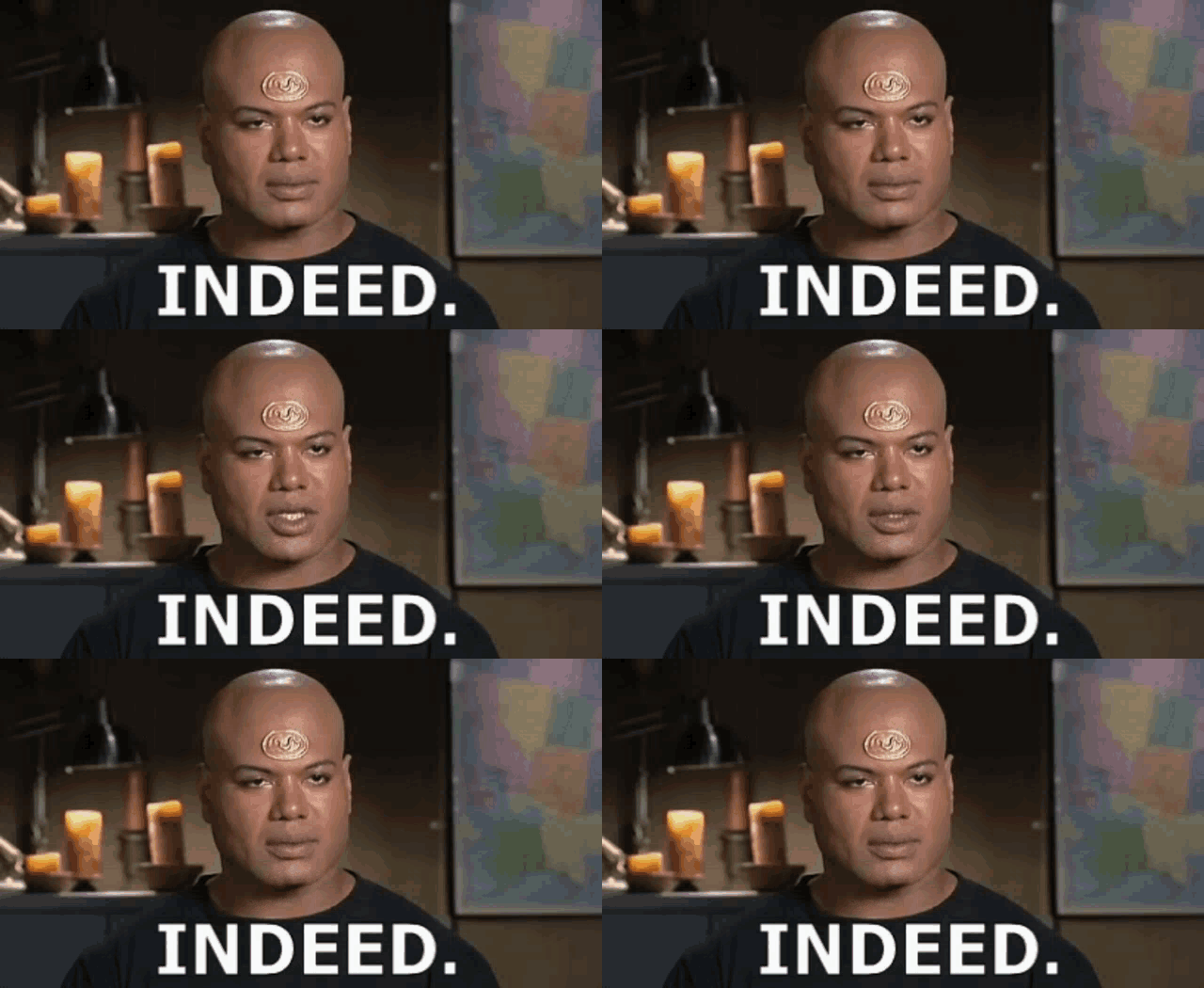
Meanwhile, Michael Shanks has been loudly disputing the studio's excuses on social media, Rachel Luttrell and Robert Patrick are helping mobilize the alumni, and Christopher Judge himself took to X during the Culver City flyover to declare: "#SaveStargate Indeed!" When the actors break ranks to stand shoulder-to-shoulder with the fans, it sends a clear signal to the industry: this universe is too vibrant, too loved, and too valuable to be left on a shelf.
The organized push has a central command base. If you want to know exactly how to push back constructively, find the latest campaign updates, or sign the petition, check out the dedicated hub at SaveStargate.
Amazon still owns the IP, and reports indicate they are still actively trying to find a way forward with the franchise. By refusing to quiet down, by ratioing the corporate feeds, and by literally flying our demands over their executive suites, we are reshaping the data they care about most. We are proving that a show built on optimism, heart, found family, and genuine adventure isn't a financial risk—it is a goldmine.
The gate isn't buried. It's just waiting for enough power to lock the chevron. Keep tweeting, keep making memes, and keep sending the signal. Because undomesticated equines couldn't stop this fandom if they tried.